Ten free coloring sheets inspired by eighteenth-century botanical plates. Explore dandelion, lavender, fruiting branches and more, then choose a US Letter or A4 PDF. Each sheet has a historical source and a printable line drawing.
Creation disclosure: These are new, AI-assisted, code-authored vector interpretations after Elizabeth Blackwell’s A Curious Herbal. They are not her original engravings, hand-drawn CBA artwork or exact botanical reproductions. No generative raster images or archive scans are used in the downloads.
This small pilot ranges from simple fruit and broad leaves to finer flower and foliage details. Choose a page that suits the space you like to color.
Download all 10 sheets — US LetterDownload all 10 sheets — A4Choose a botanical coloring sheet
1. Dandelion
A rosette of toothed leaves, open flower heads and a seed head. The historical title is Dens Leonis.
 Download Dandelion — LetterDownload Dandelion — A4
2. Mayweed
Fine branching foliage and daisy-like flower heads. The source calls this May-Weed or Faetid Camomile; it is not a culinary chamomile guide.
 Download Mayweed — LetterDownload Mayweed — A4
3. Acanthus
Broad lobed leaves and a tall flowering spike, adapted from the Bears Breech plate.
 Download Acanthus — LetterDownload Acanthus — A4
4. Peach
Long narrow leaves, rounded fruit and a separate blossom study, based on the Peach Tree plate.
 Download Peach — LetterDownload Peach — A4
5. Fig
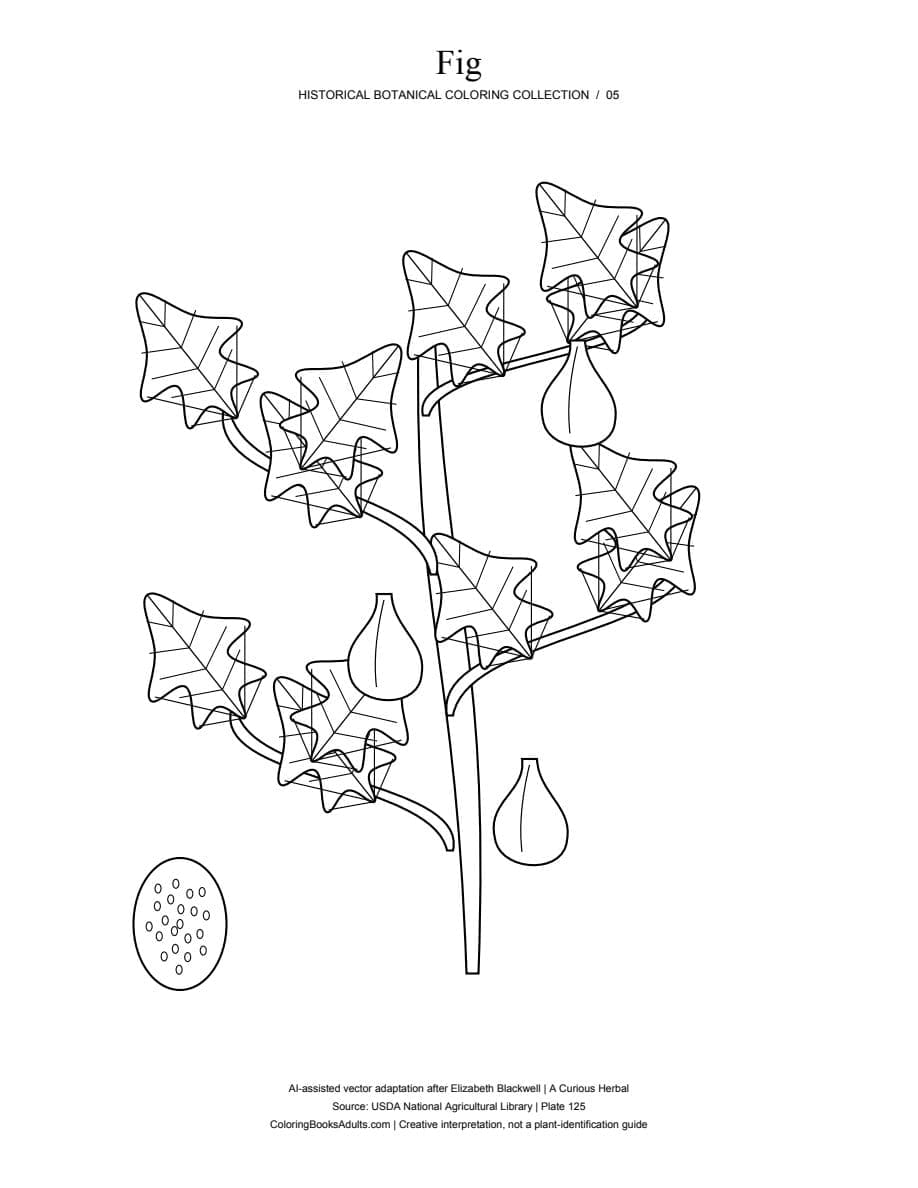
Deeply lobed leaves and hanging figs, with a separate cut-fruit study.
 Download Fig — LetterDownload Fig — A4
6. Quince
Broad leaves and irregular rounded fruit, with a small blossom study, based on the Quinces plate.
 Download Quince — LetterDownload Quince — A4
7. Tobacco
Large leaves and tubular, star-ended flowers. Included as historical botanical art, with no endorsement of tobacco use.
 Download Tobacco — LetterDownload Tobacco — A4
8. Grapevine
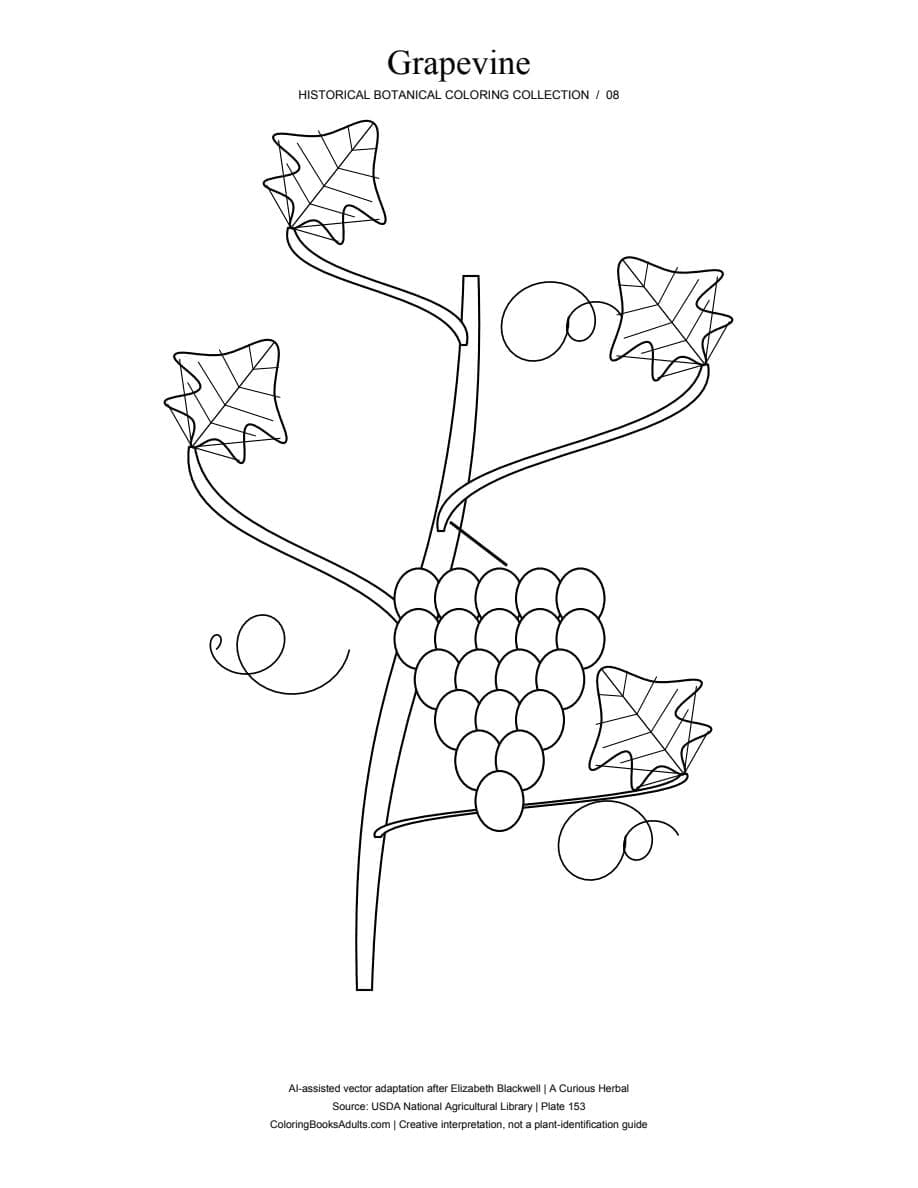
Lobed leaves, curling tendrils and a hanging fruit cluster, based on The Vine plate.
 Download Grapevine — LetterDownload Grapevine — A4
9. Sassafras
A branching stem with several leaf forms, including the distinctive mitten-shaped outline seen in the source.
 Download Sassafras — LetterDownload Sassafras — A4
10. Lavender
Slender stems, narrow leaves and compact flowering spikes, based on the Lavendula plate.
 Download Lavender — LetterDownload Lavender — A4
From a historical herbal to a coloring page
Blackwell’s A Curious Herbal was published in 1737–1739. Its drawings, engravings and coloring are attributed to her in the Biodiversity Heritage Library catalogue, which identifies the work as public domain. The individual source plates linked above are held online by the USDA National Agricultural Library; its catalogue uses a broader 1737–1771 date range. These dates describe different catalogue records, not a new publication date for our adaptations.
We used the plates to study recognizable leaf, stem, flower and fruit forms, then composed simplified vector designs with open spaces for coloring. Fine engraved shading, historical lettering and many scientific detail studies were left out. The sheets are creative interpretations and should not be used to identify plants or follow historical medical advice.
Printing these sheets
- Choose Letter for 8.5 × 11-inch paper or A4 for 210 × 297 mm paper.
- Open the downloaded PDF in your preferred PDF viewer. Use “Fit” if your printer requires wider margins.
- Print one sheet as a test before the full pack. Use thicker paper suitable for your printer if you plan to use markers.
- The files contain black vector outlines on white paper. All ten sheets have at least a half-inch design margin on Letter; the A4 versions use the same artwork scaled to fit.
For paper choices and marker bleed-through, see our coloring page printing guide. Explore the nature collection for fuller scenes, or the Human-Drawn Printable Directory for externally sourced artist downloads.
Usage and source rights
You may print these new CBA adaptations for personal, non-commercial use and non-commercial classroom activities. Please link to this collection instead of redistributing our files. This permission does not restrict the historical public-domain originals, which you can access independently through the source collections. USDA hosting alone is not the basis of our public-domain assessment.
Help shape the next collection
This is a ten-sheet pilot. After trying a page, send us feedback with “Historical Botanical Pilot” in the subject. Tell us which plant you colored, whether the line detail felt too simple or too crowded, your paper size and any printing problem. A photo of your finished page is optional.
Feedback is used to review this pilot. Sending a photo does not grant permission to publish it; we would ask separately before featuring it.